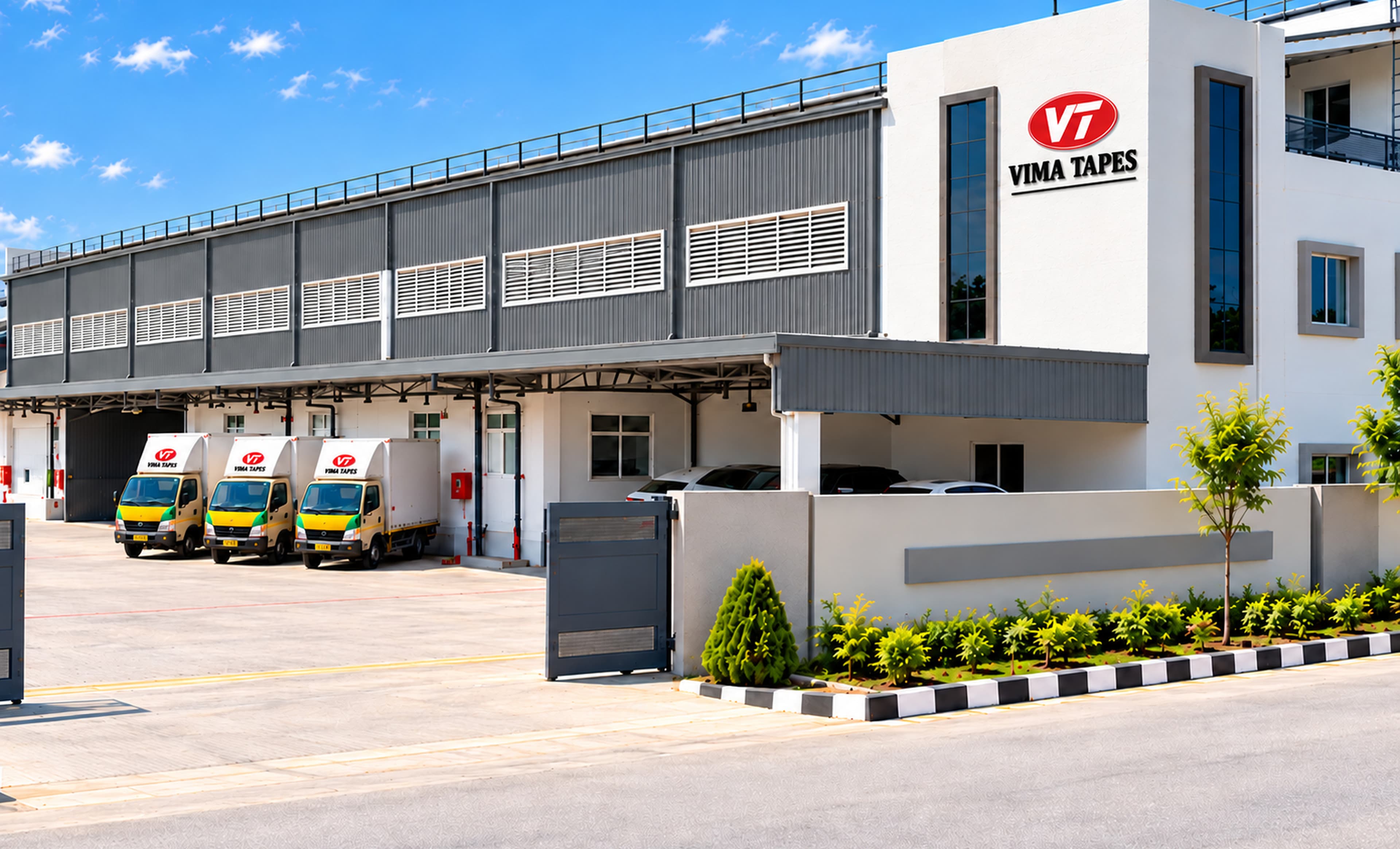
VIMA TAPES Manufacturing Infrastructure Plant in Avinashi, Tirupur
VIMA TAPES · Manufacturing & Quality Control

Adhesive Tape Manufacturing Process: From Raw Materials to Final Dispatch

A detailed look at how BOPP self-adhesive packaging tapes move through raw material selection, laboratory testing, precision coating, optional custom printing, jumbo roll conversion, slitting, quality inspection, carton packing and order dispatch.

At VIMA TAPES, our manufacturing operations in the Avinashi–Tirupur region support transparent tapes, brown cello tapes, colour tapes and custom printed BOPP tapes. We also provide paper gum tape solutions, which use a different paper backing and adhesive/application process. This page explains the shared packaging-tape workflow while clearly identifying the steps that differ between BOPP and paper-based products.

For industrial buyers searching for a BOPP tape manufacturer in Tamil Nadu, a packing tape manufacturer, a carton sealing tape supplier or a custom printed tape manufacturer, understanding the manufacturing process provides useful context for product selection, quality discussions and order planning.

Step-by-Step Manufacturing Process

From Raw Materials to Finished Tape & SafeDispatch — 6 Detailed Stages

Follow the VIMA TAPES process from BOPP film and acrylic gum through controlled coating, semi-finished jumbo rolls, slitting to customer sizes, protective packing and dispatch. Film and gum are shown separately within Stage 01. Every stage includes a dedicated image space for original production photographs.

MANUFACTURING STAGE 01 / 06

Raw Material Selection & Preparation

Every reliable carton sealing tape starts with the correct raw materials. At VIMA TAPES, the essential inputs for conventional BOPP self-adhesive packing tapes are a suitable polypropylene backing film and a compatible water-based acrylic pressure-sensitive adhesive, often called gum. These materials are procured and handled separately. They are examined for their intended use before the coating operation begins, because consistency at the raw-material stage influences coating uniformity, adhesion, winding performance and the appearance of finished tape rolls.

1 (i) BOPP Film — Primary Backing Material
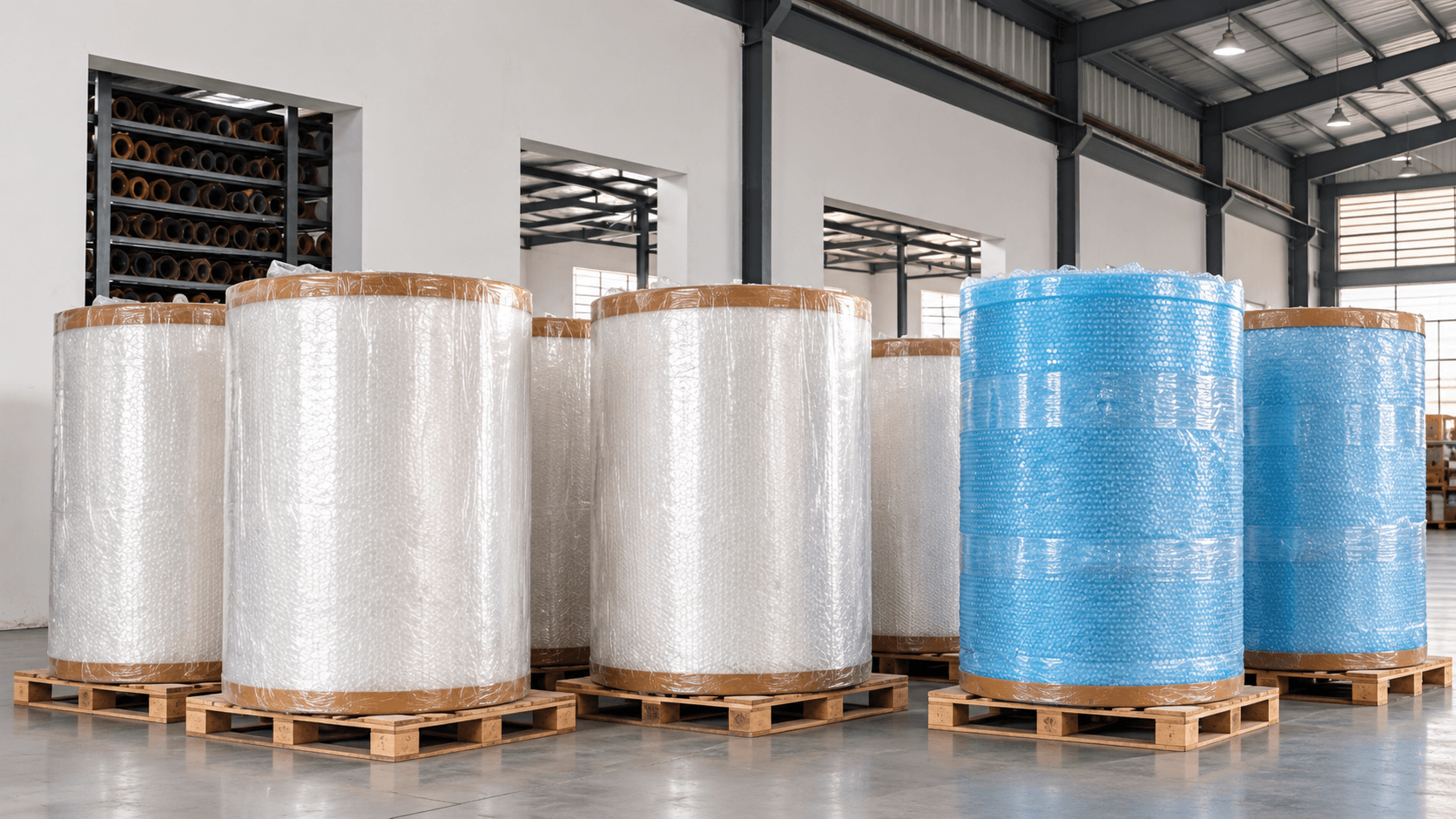
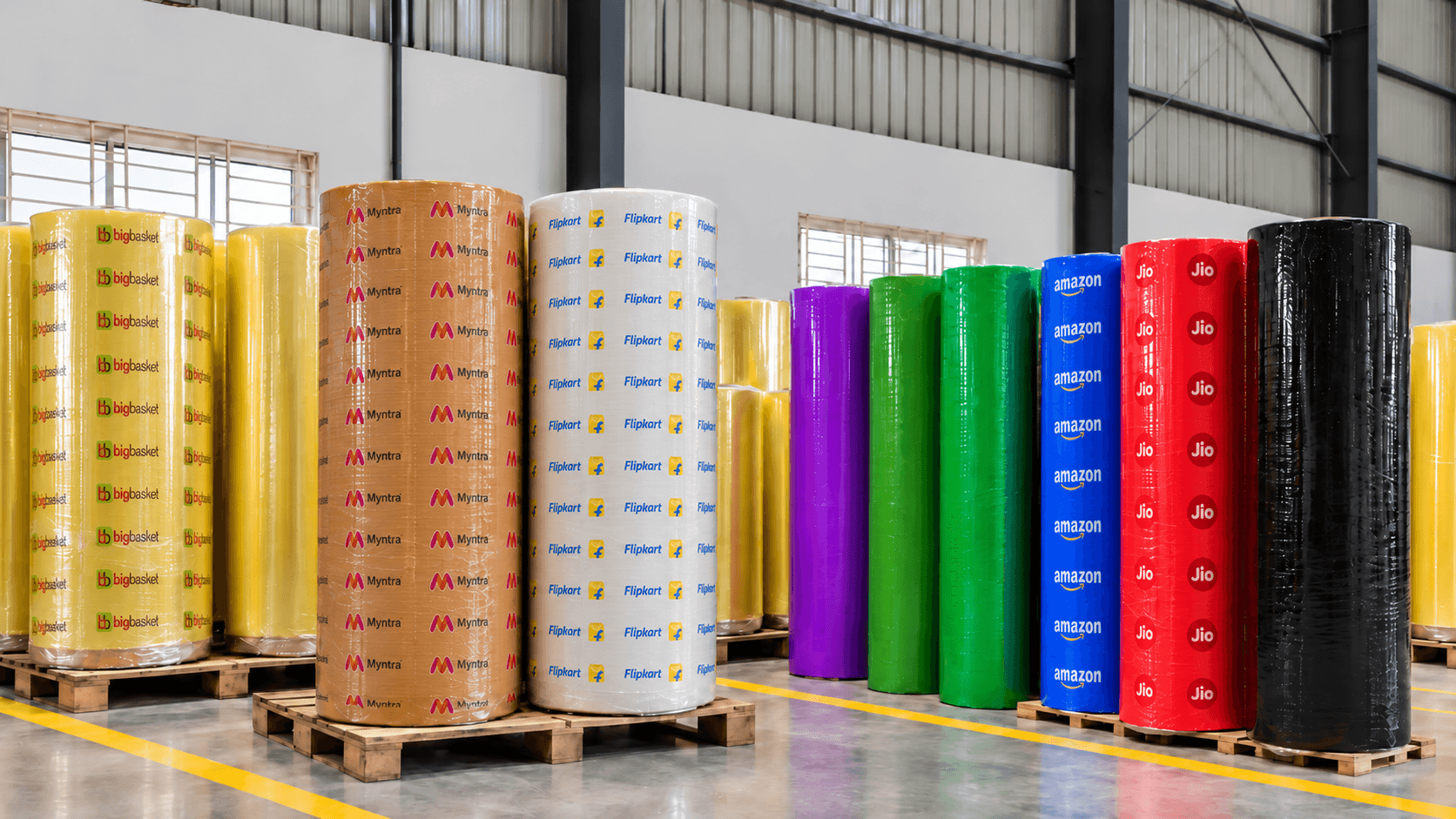
BOPP film raw-material master rolls — VIMA TAPES Warehouse

The film used for most transparent, brown and colour BOPP packaging tapes is Biaxially Oriented Polypropylene (BOPP) film. Biaxial orientation means the polypropylene film has been stretched in two directions during its manufacture to develop useful mechanical and dimensional characteristics. The film acts as the backing or carrier for the acrylic adhesive coating. In ordinary packaging applications, it provides flexibility, tensile strength, dimensional stability and, where required, clear visibility through the tape.

VIMA TAPES procures film in wide industrial rolls. The selected type depends on whether the order is for transparent cello tape, brown packing tape, coloured tape, printed BOPP tape or another compatible product configuration. Raw material may differ in colour, thickness, treatment and intended surface characteristics. A transparent tape requires a clear backing, while colour tape uses a suitable coloured film or approved colour construction. The appropriate material is chosen to fit the order and its final required performance.

At the receiving and storage stage, rolls are identified and kept ready for production planning. The team checks that the supplied material is suited to the relevant tape grade. Handling must avoid unnecessary contamination, excessive edge pressure, damage to roll surfaces and improper storage conditions. Even an otherwise acceptable film can create problems if it is distorted, scratched or contaminated before coating.

Key film properties and what they affect:
  • Film thickness: influences the overall tape construction and must be considered together with the later adhesive layer when establishing the nominal finished-tape thickness.
  • Film clarity and colour: determine the visual appearance of transparent, brown, tinted and coloured packing tapes.
  • Tensile behaviour: supports resistance to stretching and film breaks during unwinding, slitting, carton sealing and normal handling.
  • Surface condition and treatment: influence the ability of the adhesive coating to wet and remain anchored to the designated side of the film.
  • Roll width, winding and edge condition: influence smooth machine loading, web tracking, low-waste coating and later conversion into the correct tape sizes.

Film thickness and tape thickness are not the same. For example, one provided transparent tape Certificate of Analysis identifies 23 microns film + 22 microns glue = 45 microns nominal composite tape thickness. Another sample uses 25 microns film + 23 microns adhesive = 48 microns nominal thickness. These are two specific product samples, not universal constructions for every available tape grade.

By carefully selecting the BOPP backing, VIMA TAPES prepares a stable material base for the following adhesive coating process. This is especially important for bulk manufacturing, where consistent film behaviour helps reduce avoidable machine adjustments and improves repeatability across long industrial production runs.

1 (ii) Water-Based Acrylic Adhesive (Gum)
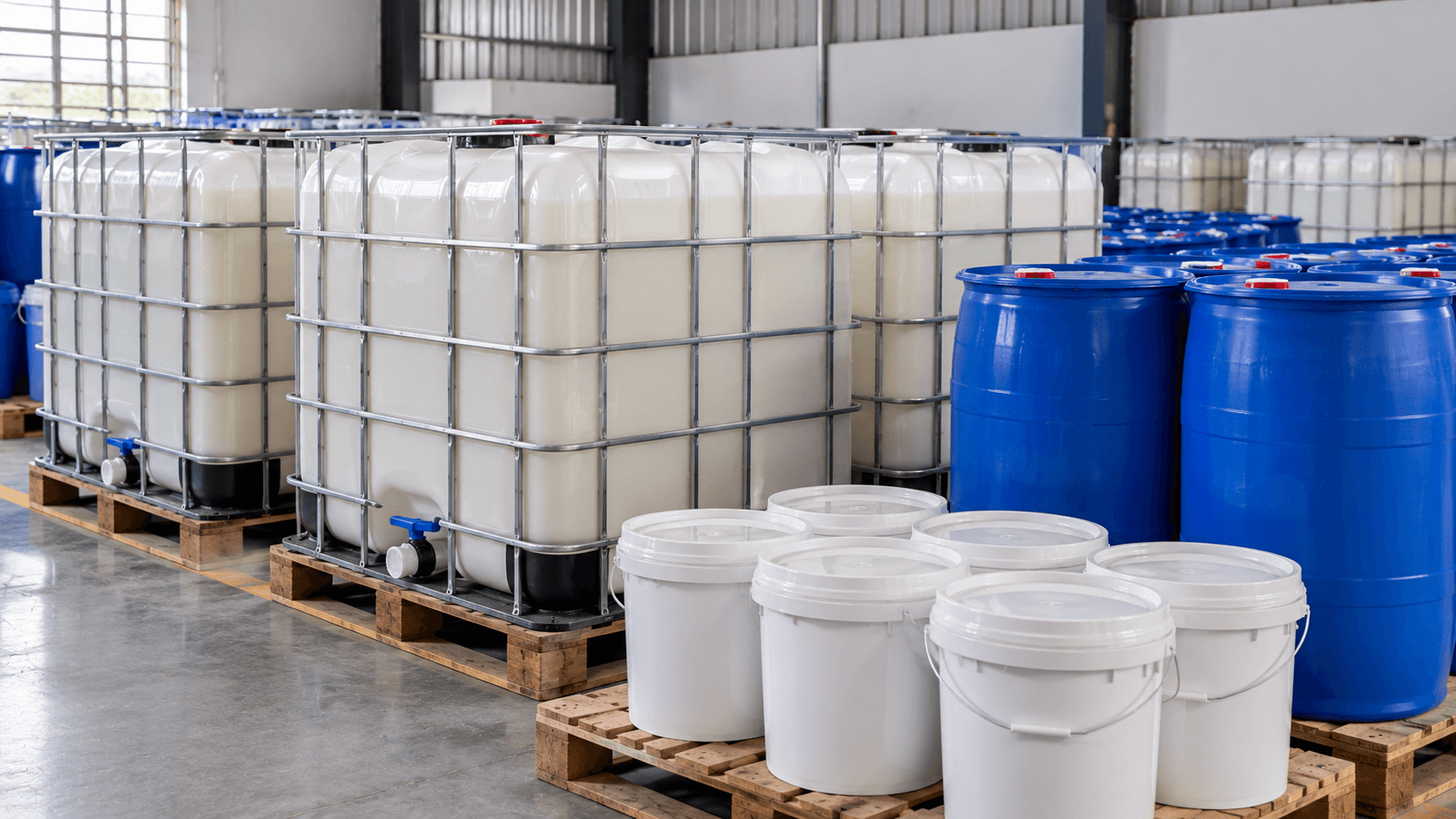
Water-Based Acrylic Adhesive Containers and Storage Area — VIMA TAPES

The second principal raw material is water-based acrylic pressure-sensitive adhesive (PSA). In everyday factory terminology it is called “gum”. Unlike a water-activated adhesive, this acrylic adhesive is formulated to remain pressure-sensitive after its carrier water has been removed in the drying process. It provides the sticking or bonding function when the tape is pressed onto a suitable corrugated carton or other compatible packaging surface.

The adhesive is procured separately and received in industrial containers. Incoming materials are kept identifiable so that the approved adhesive grade can be matched to the scheduled BOPP tape product. Suitable storage and handling practices help reduce contamination, unplanned changes in viscosity, excessive foaming and other conditions that can complicate coating. The material is prepared for transfer to the coating system only after the required incoming checks and production requirements have been reviewed.

The adhesive layer influences important tape characteristics such as initial tack, peel adhesion, shear holding power, coating continuity and application performance. The amount of gum applied is carefully controlled: a visually thick coating is not automatically a better coating, and a strong tape must be evaluated as a complete film-and-adhesive construction rather than judged by adhesive quantity alone.

Incoming Gum Quality Testing

Before coating, VIMA TAPES performs important preliminary evaluations of the supplied acrylic adhesive. The available sample values reported for this process are viscosity 54.16, pH 9.57 and solid content 19.77. These figures are sample readings. They require the applicable methods, units and approved acceptance ranges before they can be described as standard limits or universal product claims.

Incoming adhesive testReported sampleTechnical purpose
Viscosity54.16Indicates resistance to flow; helps assess pumping, mixing, transfer, coating uniformity and the ability of the adhesive to spread across the film.
pH9.57Indicates acidity or alkalinity and provides a useful indicator of water-based acrylic emulsion condition and batch consistency.
Solid content19.77Indicates non-volatile content relevant to the dry adhesive remaining after water is removed; confirm whether the report states a percentage.
Why Viscosity is Tested

Viscosity is the resistance of the gum to flowing. Excessive change from a validated range may influence coating weight, edge-to-edge distribution, wetting, machine feed and surface quality.

Why pH is Tested

The pH reading of 9.57 describes the alkaline condition. The pH of an acrylic emulsion is associated with formulation stability and process behaviour across incoming batches.

Why Solid Content is Tested

Solid content indicates how much non-volatile material remains after drying. It helps technicians understand wet-to-dry coating relationships and estimate deposited adhesive.

Additional checks such as foaming observation, appearance, contamination and handling consistency may be included according to the relevant laboratory procedure. These early evaluations do not replace finished-tape peel, shear and tack testing; they serve a different purpose by assessing whether the incoming gum is suitable for the next production stage.

Additional Technical Details & Process Controls — Stage 01

Film selection for different finished tape constructions

Although transparent, brown, colour and many custom printed packing tapes share BOPP as the main backing, the backing film must be chosen for the intended final appearance and specification. Transparent packing tape benefits from a clear, consistent film. Brown and colour tape orders require appropriate colour characteristics, whether from an approved coloured film or another qualified production route. The visual appearance of the raw material must not be confused with the appearance of the finished adhesive-coated tape. The selected film grade must also be compatible with the adhesive and with any approved printing or converting operation.

Incoming material control and storage discipline

The material identification, supplier description and relevant roll data are reviewed before production. Rolls should be handled so that exposed film edges are protected from knocks, contamination and accidental abrasion. Dust, film wrinkles, uneven roll tension and defects can become more difficult to correct once the web is travelling at coating-line speed. Material movement from storage to coating is therefore an important part of the overall manufacturing workflow, rather than simply a transportation step. Good identification also helps teams keep grades and customer requirements separate.

Adhesive receiving, cleanliness and batch consistency

Water-based acrylic pressure-sensitive adhesive is a liquid emulsion and is stored and handled separately from dry film. Before it is introduced to the production system, personnel verify the container condition, product identification and suitability for the planned tape grade. Appropriate, clean transfer equipment helps avoid contamination by dirt or material from a previous batch. Where mixing or filtration is part of the approved operating procedure, it must follow the relevant material instructions. The purpose is to deliver a stable and consistent adhesive to the coating station—not to claim that VIMA TAPES synthesizes its acrylic polymer from monomers on site.

How viscosity, pH and solid content work together

A result for viscosity alone cannot establish adhesive quality. Viscosity tells the coating team how readily the material flows at a defined test condition; pH gives information about the acid–alkaline condition of the emulsion; and solid content helps estimate how much non-volatile adhesive material remains after drying. These properties are complementary. For example, a stable-looking emulsion could still have a changed solids level that affects final dry coat weight. Likewise, two adhesives with similar solids readings may behave differently on the line if viscosity differs. Results are interpreted as a set, together with supplier specifications and downstream coating behaviour.
MANUFACTURING STAGE 02 / 06

Precision Gum Coating & Adhesive Application

The controlled application of water-based acrylic gum is the central stage of BOPP tape manufacturing. This is where prepared film is transformed into adhesive-coated material ready for jumbo-roll winding and further conversion.

Precision Gum Coating & Adhesive Application — VIMA TAPES

The coating stage converts selected BOPP film into pressure-sensitive adhesive tape material. After incoming material checks, the film master roll is positioned at the unwinding station of the selected coating line. The material is carefully threaded through the machine path and aligned so that it can travel consistently over the guiding, drive and application rollers. Stable web tracking and controlled tension help prevent wrinkles, unwanted stretching and off-centre movement.

VIMA TAPES operates three coating-machine sets of different sizes to support varying production requirements. The production team selects a suitable machine based on the film configuration, coating job, planned output and approved product specifications. Each line is operated using machine settings appropriate to the particular coating run, rather than assuming that every tape grade uses the same application rate or speed.

Water-based acrylic gum is introduced into the coating arrangement. The machine applies a measured adhesive layer to the intended surface of the BOPP web while the film moves continuously. Operators control the relevant parameters, which may include machine speed, web tension, adhesive flow, coating coverage and visual uniformity. The objective is an even and consistent coating from one part of the film to the next and across the usable width.

What happens during the actual coating operation?

  • Master-roll loading: the selected film is mounted and secured for controlled unwinding.
  • Film threading and alignment: the web is guided through rollers and maintained in the intended path.
  • Adhesive feed: approved water-based acrylic adhesive is delivered to the coating application section.
  • Uniform gum application: the gum is transferred across the designated film surface to form the wet adhesive layer.
  • Process monitoring: operators observe flow, web movement, defects, tension and coating appearance as the line runs.
  • Drying: the coated film passes through a suitable drying arrangement where water is removed under controlled conditions.
  • Preparation for rewinding: the film with its developed adhesive layer is guided toward the jumbo-roll winding section.

A key distinction is that coating does not merely make the film look glossy; it creates the functional adhesive layer that allows the finished roll to act as carton sealing tape. Uniformity matters because local gaps, bubbles, coating streaks or excessive variation can affect the tape’s ability to stick predictably in practical packaging applications.

Plain, Coloured and Printed Tape Configurations

The underlying adhesive-coating principle is relevant to conventional transparent, brown and compatible colour BOPP tapes. The selected film provides the appearance and the gum provides the pressure-sensitive adhesion. For approved custom printed adhesive tapes, the customer logo, company name, repeat design or handling message is transferred using a prepared printing cylinder as part of the appropriate production or conversion route. The print location and sequence depend on whether the tape is surface-printed, reverse-printed or otherwise constructed.

Custom printed VIMA TAPES offerings discussed for customers include transparent, brown, milky white, tinted and reverse-printed configurations, as well as single-colour, two-colour and up to three-colour artwork options where technically suitable. Reverse printing describes the position of the print within the tape structure; it is not itself a separate raw backing material. Artwork clarity, approved colour, cylinder alignment and repeat length must be checked before running branded material.

Key Coating Controls & Quality Checkpoints

  • Wet coating uniformity: maintain the planned layer thickness and avoid gaps or uneven adhesive distribution.
  • Film stability: check that winding and handling do not introduce creases or unwanted elongation.
  • Drying consistency: allow controlled removal of water without damaging the backing film or adhesive.
  • Surface observation: monitor visible coating defects, bubbles, streaking and edge contamination.
  • Job identification: confirm that the run corresponds to the requested tape grade, appearance and relevant printed artwork.
Construction example from supplied COA records:

A nominal 45-micron clear tape sample lists 23-micron film and 22-micron glue thickness; a nominal 48-micron sample lists 25-micron film and 23-micron glue thickness. Actual overall sample measurements were 45.5 and 48.5 microns respectively. These batch examples illustrate film-plus-adhesive construction; they do not prescribe the coating for every product in the VIMA TAPES catalogue.

Additional Technical Details & Process Controls — Stage 02

Coating line setup and web-threading sequence

A master roll of film is mounted in the unwind area and the web is threaded along the designated roller path. Operators establish film tracking, web alignment and a steady tension before running the line at the planned operating speed. The adhesive is delivered to the application system and spread over the required side of the moving film. The three coating-machine sets at VIMA TAPES support different production requirements; configuration and operating parameters are selected for the approved grade, not assumed identical for every machine. Consistent tracking protects usable width, prevents avoidable edge loss and supports a steady finished roll.

Adhesive application, wet coat and dry coat

At the point of coating, the liquid adhesive forms a wet layer. The water in this coating is subsequently removed under controlled drying conditions, leaving the functional acrylic adhesive layer on the BOPP backing. Wet coating quantity and adhesive solid content both influence the amount of dry material remaining. Film thickness and dried adhesive thickness together contribute to overall tape thickness.

Coating defects operators look for

The team observes the travelling film for signs of uneven coverage, streaks, small voids, foaming, edge buildup, wrinkles or other irregularities. Such issues can influence appearance, adhesion and the quality of later slitting. A visible defect may originate in film handling, adhesive condition, applicator settings or drying behaviour; identifying it early reduces the quantity of material requiring further inspection. Regular observation and an established production recipe support consistent performance across long industrial tape runs.

Plain, colour and printed tape process differences

A plain transparent tape requires a clear, clean and evenly coated appearance; brown carton sealing tape requires a uniform approved brown appearance; colour coding tape requires consistent shade and coated performance. Custom logo tape also needs approved artwork and accurate repeat placement. Printing cylinders reproduce the agreed brand name, handling instruction or logo in a repeat pattern, using a suitable print route for the specific construction. Transparent, brown, milky white, reverse printed and tinted variants do not all use exactly the same print layering.

MANUFACTURING STAGE 03 / 06

Semi-Finished Tape & Jumbo Roll Formation

Following coating, the web is dried and wound into larger semi-finished rolls. These large rolls form the bridge between the coating machine and the precision slitting and rewinding operations.

Adhesive-Coated BOPP Jumbo Rolls after Drying and Rewinding — VIMA TAPES

After the gum has been applied, the coated BOPP web passes through drying and stabilisation before it is wound into large industrial rolls. The drying step removes the required water from the adhesive emulsion so the coating can function as a pressure-sensitive adhesive layer. The temperature, airflow, contact time and web speed must be coordinated with the product and machinery to avoid unnecessary film distortion and inconsistent adhesive behaviour.

The coated and dried material is then rewound into a jumbo roll or semi-finished adhesive tape roll. At this point the material already has the essential tape construction: BOPP backing plus adhesive coating. However, it has not yet been converted into final customer-sized rolls, fitted and rewound to the intended branded cores, packed into the specified number of pieces per box or released for dispatch.

The large roll format is useful because a single production run can later be converted into different widths and ordered lengths. It separates the continuous high-speed coating stage from the precise conversion required for finished retail, commercial and industrial tape rolls. VIMA TAPES can plan slitting according to orders for transparent packing tape, brown cello tape, colour tape and compatible printed tapes.

Why the Semi-Finished Jumbo Stage Matters

  • Consistent coating continuity: the wide roll represents a continuous length of coated tape material that can be inspected before conversion.
  • Production scheduling: the coating line can complete a suitable run while later slitting is scheduled to match individual customer specifications.
  • Material handling: controlled jumbo roll storage and movement protect the coated web from damage before conversion.
  • Winding stability: correct tension and roll structure help avoid loose winding, telescoping, creasing and edge distortion.
  • Traceability: rolls are associated with the relevant product grade or production record as required by the factory workflow.

Operators examine the finished jumbo rolls for visible winding and coating problems. Important observations include edge condition, appearance, roll shape, winding tightness and any defects that could continue into many small rolls if left unresolved. Issues discovered here can be addressed before the large roll is committed to the next conversion stage.

For buyers, this stage explains why an industrial BOPP packing tape manufacturer can support multiple finished widths and lengths without treating every size as an unrelated product. The jumbo-roll-to-slitter process provides flexibility while the coated film construction and applicable quality requirements remain consistent with the approved tape grade.

Plain, Colour and Printed Jumbo-Roll Variations

A clear jumbo roll may appear transparent or pale amber depending on lighting, coating and the actual backing material. Brown and colour tape construction may be visibly tinted or coloured. Approved custom printed designs can also appear as repeated logos, text or symbols along the web where the production path calls for printing before final conversion. A printed jumbo roll is still semi-finished until the correct final slit width, meter length, winding and packaging checks are completed.

Important distinction:

The jumbo roll is a semi-finished stage, not the same as a final customer-ready tape roll. Customer-ready quantities, branded core presentation, size confirmation, final quality checks and packing happen later in the workflow.

Additional Technical Details & Process Controls — Stage 03

From moving coated film to manageable industrial rolls

Drying does not mean simply exposing film to heat. The process must allow the required removal of water from the adhesive while keeping web travel stable and avoiding damage to the backing. After the appropriate coating condition is achieved, the wide web is wound in a controlled manner. The result is a semi-finished or jumbo roll ready for later conversion. This stage is especially important for an industrial BOPP tape manufacturer because it separates continuous high-volume coating from the order-specific requirements of small finished rolls.

Why correct jumbo winding matters

Web tension, roll alignment and winding behavior affect whether the jumbo roll can later unwind smoothly through a slitting machine. If the roll is wound too loosely or unevenly, the material may telescope or wander, making clean conversion difficult. Excessive or inappropriate winding tension can also contribute to roll defects. The team therefore looks for a stable roll structure, consistent edges and acceptable coated appearance before the roll is moved into the conversion area.

Product identity during the semi-finished stage

Different orders may require the same nominal width but different tape lengths, colours, prints or overall thicknesses. At the jumbo-roll stage, the material needs to remain associated with the relevant product or job specification. This provides a logical connection between upstream coating and downstream slitting, where the actual customer-size rolls are created. It also helps avoid mixing standard transparent rolls with brown, colour or artwork-specific material.

Checks before a jumbo roll is released for slitting

The process team may review visible film and adhesive condition, edge straightness, winding quality and suitability for the next machine. Samples may be taken for relevant quality evaluations under the established sampling plan. Only the approved material should continue to size conversion. In a customer-facing manufacturing explanation, it is important to describe this as a quality checkpoint without suggesting that every roll receives every destructive laboratory test individually.

MANUFACTURING STAGE 04 / 06

Precision Slitting into Customer Sizes

At the slitting stage, wide adhesive-coated rolls are converted into the individual tape sizes and lengths requested by businesses. Seven precision slitter machines form part of the stated VIMA TAPES production infrastructure.

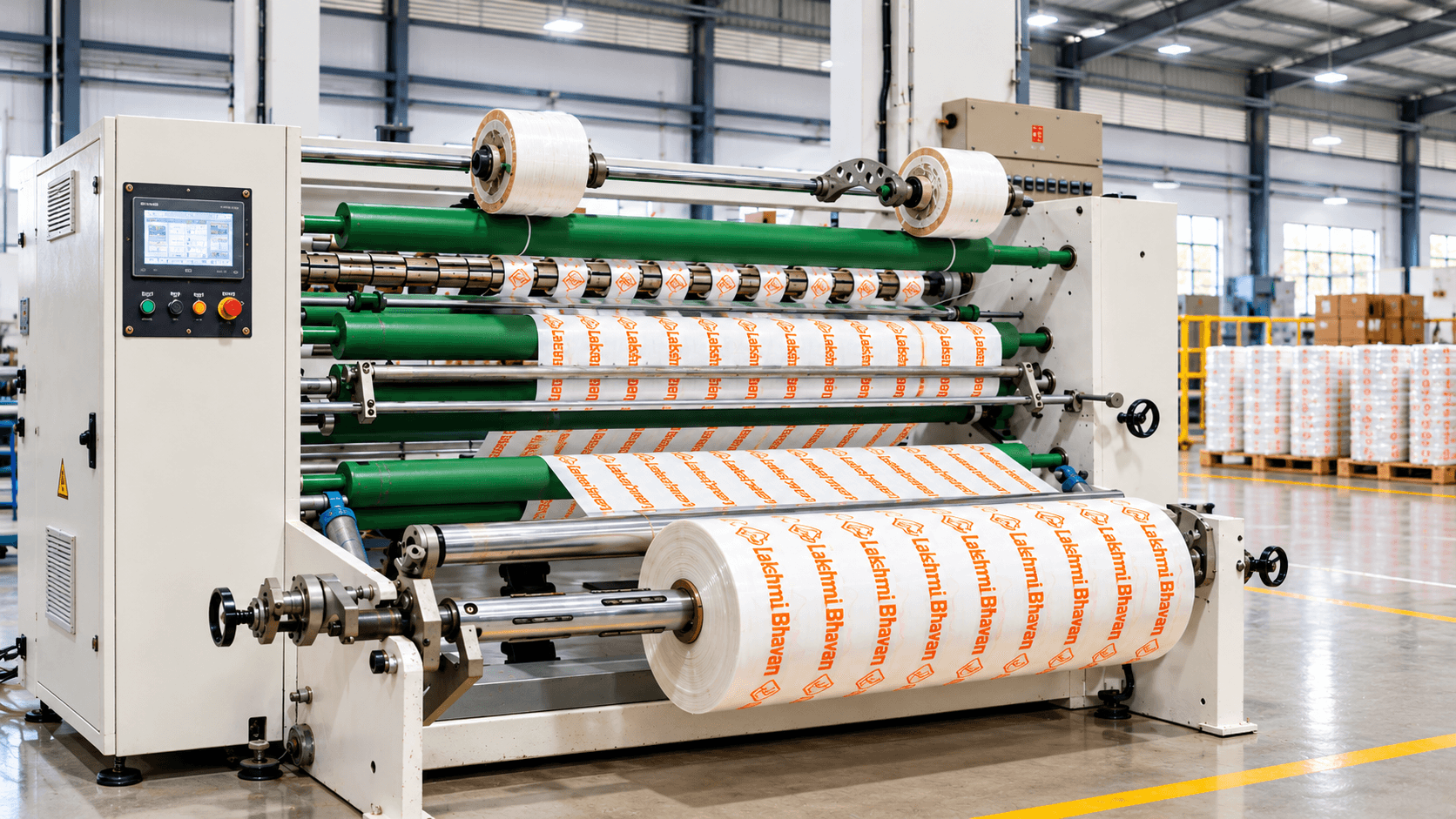
Lakshmi Bhavan Precision Slitter Rewinder Machine Converting Jumbo Rolls into Customer Sizes — VIMA TAPES

Slitting converts the large coated jumbo roll into individual adhesive tape rolls that customers use in carton sealing, manual packing, industrial packaging lines, product bundling and shipment preparation. Before the slitting job begins, the selected jumbo material, requested roll width, length, quantity and packing configuration are confirmed against the order or planned manufacturing specification.

The paper cores are prepared in advance. For the VIMA TAPES brand, the inner core carries the red oval VT logo and the matching VIMA TAPES wordmark. These pre-designed core sleeves are available for the slitting/rewinding process, helping the finished rolls show the correct manufacturer identification while leaving the outer tape surface plain unless the customer has ordered an approved printed design.

The jumbo roll is mounted in the slitter/rewinder, the web is threaded through the cutting and winding path and the machine is adjusted to the required dimensions. Precision cutting tools divide the wide web into narrower strips. The strips are wound onto suitable cores under controlled tension and the machine is set to produce the ordered roll length. The accuracy of these actions influences edge finish, unwind experience, finished roll presentation and packing consistency.

Common Widths and Customer Size Options

Nominal formatCommon metric widthTypical use
½ inch class12 mmNarrow sealing, bundling and selected stationery/packing uses
1 inch class24 mmLight packaging, bundling and compact box sealing
2 inch class48 mmPopular carton sealing and standard packing requirements
2½ inch class60 mmWider sealing coverage for selected packaging needs
3 inch class72 mmWide carton sealing and selected industrial requirements

Standard product lengths previously specified for VIMA TAPES include 50 metres, 65 metres and 100 metres on applicable BOPP tape grades. Some custom printed configurations have been discussed at 60 metres and 100 metres. The final available length depends on the selected product, core, thickness, machinery setup and confirmed order.

Machine Adjustments During Slitting and Rewinding

  • Blade location and spacing: set for the requested width and consistent edge formation.
  • Material tracking: keep the jumbo web centred and moving through the correct slitting path.
  • Core positioning: align pre-printed VIMA TAPES cores with the individual tape lanes.
  • Rewind tension: control roll hardness, neat winding and smooth dispensing characteristics.
  • Meter-count settings: wind the ordered tape length rather than assuming a standard length for every job.
  • Print alignment: for printed cello tape, check repeat graphics, readability and placement after the web is slit.

A completed slitting job is inspected for clean edges, proper roll formation, winding stability, absence of visible damage and dimensional accuracy. Inspectors also examine inner-core visibility and, where applicable, printed artwork. The VIMA TAPES product range includes a selection of commonly advertised finished composite thickness grades: 36, 38, 40, 42, 45, 50 and 55 microns, with specific film and gum compositions set by the relevant grade.

Typical box-quantity examples: For certain configurations, packing counts provided are 24 mm = 144 pieces per box, 48 mm = 72 pieces per box and 72 mm = 48 pieces per box. The confirmed quotation and order determine the final configuration.

Quality Control Before Packing & Certificate of Analysis (COA)

After slitting, selected samples may be examined using the VIMA TAPES quality-control process and Certificate of Analysis (COA) records. Depending on the product and test method, parameters can include total tape thickness, peel strength, shear holding power, rolling ball tack, width, length and roll appearance. The two transparent tape COA examples previously supplied show 45.5 microns and 48.5 microns actual overall thickness, with peel results of 530 gm and 540 gm, respectively.

Sample A — Transparent BOPP tape, nominal 45 microns
ParameterDeclared / targetActual batch result
Film thickness23 microns23.0 microns
Glue thickness22 microns22.5 microns
Total thickness45 microns45.5 microns
Tape width / length72 mm / 65 m72.0 mm / 65.2 m
Peel strength480–510 gm530 gm
Shear holdingMinimum 12 hours14.2 hours
Rolling ball tack3.0–5.0 cm3.5 cm
Carton packing48 pieces / box48 pieces / box verified
Sample B — Transparent BOPP tape, nominal 48 microns
ParameterDeclared / targetActual batch result
Film thickness25 microns25.0 microns
Glue thickness23 microns23.5 microns
Total thickness48 microns48.5 microns
Tape width / length72 mm / 100 m72.1 mm / 100.2 m
Peel strength490–530 gm540 gm
Shear holdingMinimum 16 hours18.2 hours
Rolling ball tack2.5–5.0 inches3.5 inches
Carton packing48 pieces / box48 pieces / heavy-duty box
COA accuracy note: The samples have different rolling-ball-tack units (cm versus inches), so they cannot be directly compared without method confirmation. Both reported peel results are above their documented target bands; acceptance must be confirmed by the responsible quality team before any public claim of compliance. The 48-micron example is a sample grade and is not in the previously listed standard website thickness options (36, 38, 40, 42, 45, 50 and 55 microns).

Additional Technical Details & Process Controls — Stage 04

Pre-designed branded cores prepared before slitting

The paper cores are not an afterthought. Before the conversion run, suitable core stock is organized according to the planned roll size and product configuration. For VIMA TAPES branded products, the inner core carries the red oval VT symbol with VIMA TAPES identification. The prepared cores are checked for suitability before they are positioned for winding. Keeping the core print on the inner surface supports clear manufacturer identification while leaving the outer surface of plain tape free of unintended branding.

Converting a wide coated web into 1-, 2- and 3-inch rolls

The jumbo roll is mounted onto the slitter-rewinder and the material passes through a controlled path to the slitting arrangement. Cutting positions correspond to the ordered width. Common nominal conversions are 24 mm for one inch, 48 mm for two inches and 72 mm for three inches; 12 mm and 60 mm are also among the published options for relevant tapes. Blade setup and web tracking help achieve consistent edges across multiple finished rolls.

Length control: 50 m, 65 m and 100 m

Width and length are separate customer specifications. Width is established by the cutting positions, while length is established by the amount of tape wound onto each paper core. Standard BOPP tape offerings have included 50, 65 and 100 metres depending on the ordered grade. Single-colour custom printed options have also been described in 60 m and 100 m lengths.

How slitting affects the finished appearance

Clean edges matter because a poorly cut roll can look uneven, unwind irregularly or be harder for warehouse staff to apply on cartons. Correct core alignment matters because offset or deformed winding may affect how the roll fits a dispenser or packing station. Operators look for uneven edges, wrinkles, core movement, visual defects and inconsistent winding.

MANUFACTURING STAGE 05 / 06

Protective Shrink Wrapping & Carton Packing

Our packing stage safeguards the finished rolls through protective wrapping, accurate counting and organised corrugated-carton packing so they are ready for storage, transport and customer delivery.

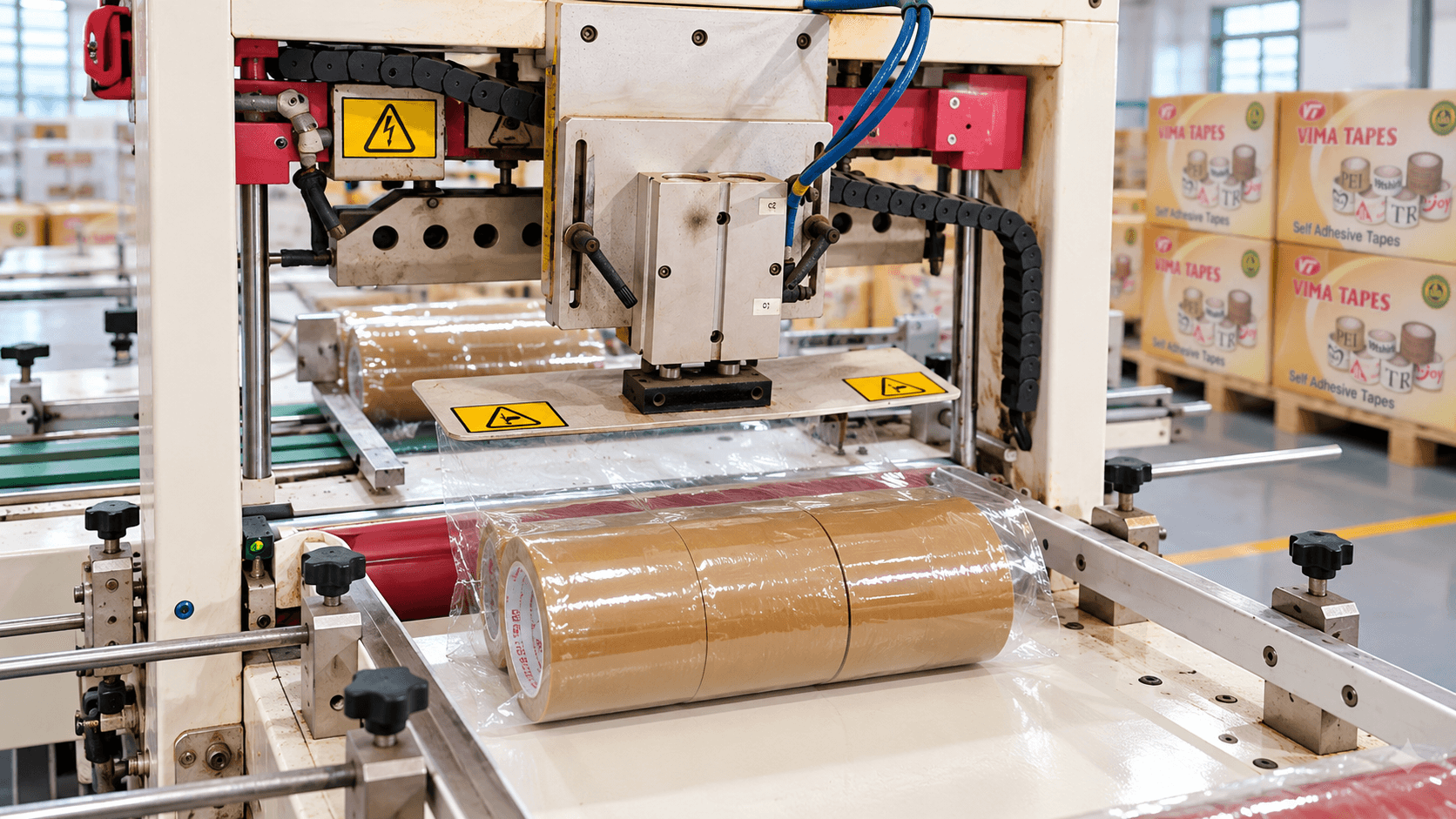
Heat-shrink packaging and neatly packed VIMA TAPES cartons

After slitting, finished tape rolls that pass the required quality checks proceed to packaging preparation. The team verifies that rolls have the requested width, length, grade, printed or plain finish and count for the order. Correct counting and identification are important because many customer orders contain more than one specification, such as multiple widths or a mix of transparent, brown and colour packing tapes.

The rolls pass through a protective shrink-wrapping or heat-shrink packaging process where used for the applicable product configuration. A machine applies a suitable protective film or sleeve around the grouped or individual tape rolls. Controlled heat causes the protective covering to tighten around the package. The purpose of this outer cover is not to activate the tape adhesive; it protects the finished rolls against avoidable dust, handling marks and surface damage while preparing them for storage and transport.

It is important that the film is applied and heated correctly so the tape reels and their cores are not distorted. Appropriate exposure and handling help create a tidy package without crushing rolls or causing visible deformation. The protective wrap is a packing layer and is distinct from the water-based acrylic gum applied earlier to the actual tape backing.

Step-by-Step Finishing and Packing Activities

  • Batch identification: separate accepted rolls by product grade, colour, size, print design and customer order.
  • Visual checks: examine roll cleanliness, tape edges, winding, inner-core branding and general appearance.
  • Roll counting: count pieces according to the applicable carton specification.
  • Protective wrapping: apply heat-shrink protective film where appropriate to reduce dust exposure and handling damage.
  • Carton selection: choose suitably sturdy corrugated cartons based on the rolls, quantity and handling requirements.
  • Neat arrangement: organise rolls inside each box to reduce unwanted movement and provide orderly stacking.
  • Order verification: confirm product type, roll measurements, piece count and dispatch identity before sealing the carton.
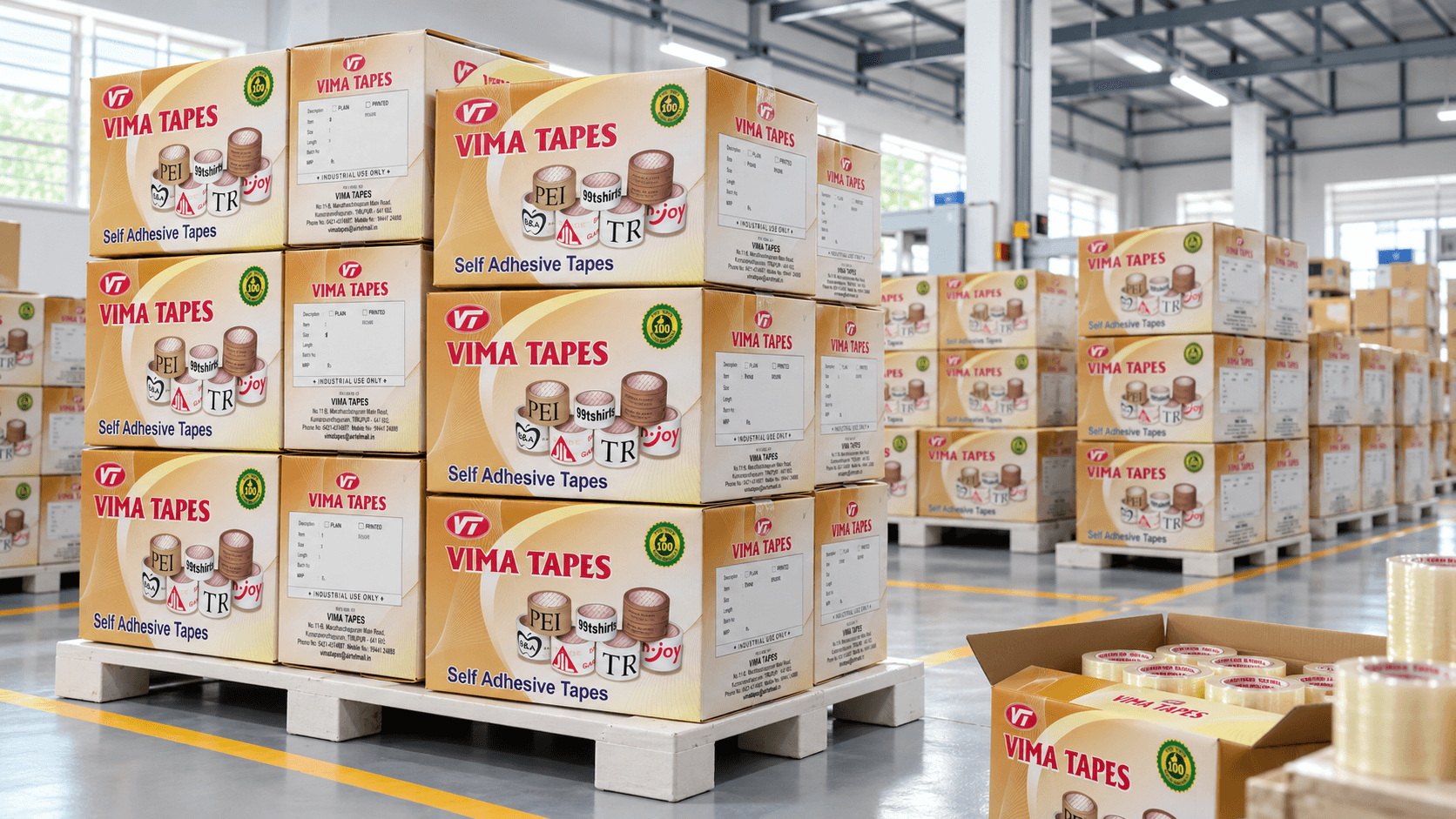
Neatly packed VIMA TAPES corrugated shipping cartons

VIMA TAPES uses suitable corrugated cartons to protect its rolls during warehousing, handling and shipment. Good carton packing considers the weight and geometry of the rolls as well as the route to the buyer. Depending on the agreed packaging format, a box may contain grouped rolls or multiple layers arranged to remain stable. The objective is to keep the finished product in good condition until it is received and opened by the customer.

Proper packing also supports distributor stock management. Buyers handling large quantities of BOPP self-adhesive tapes, brown cello tapes, custom logo tapes or transparent carton sealing tapes benefit from clear product identity and straightforward quantity checks. For bulk B2B orders, box-level separation by specification assists with inventory receipt and prevents unrelated sizes or printed designs from becoming mixed.

Presentation and branding:

The VT oval logo and VIMA TAPES name should appear clearly on the inner cores of applicable branded finished rolls. For plain tapes, no unintended printing should appear on the outer tape surface. For custom printed tapes, the exterior tape print follows the customer-approved artwork.

Additional Technical Details & Process Controls — Stage 05

Finished-roll counting and preparation

Once finished tape rolls pass the required inspection, they are counted and grouped according to the confirmed selling configuration. The group size is guided by tape width, length, roll diameter and the box specification. Counting before wrapping and cartoning helps protect order accuracy for wholesale distributors and bulk packaging-tape buyers.

Protective heat-shrink wrapping

For packaging configurations that use the shrink machine, rolls are arranged in their required pack layout and enclosed in appropriate wrapping film. Controlled heat causes the film to shrink around the grouped rolls, creating a neater, more stable bundle. This protective layer is intended to reduce direct exposure to incidental dust and handling abrasion during normal storage and movement.

Selecting cartons and organizing each order

Wrapped bundles or individual finished rolls are arranged in suitable corrugated cartons. The box is chosen for the product's weight and quantity, with attention to a snug but not damaging fit. Consistent stacking helps minimize avoidable roll movement and protects pack presentation during transportation.

Final outgoing packing checks

Before dispatch, cartons can be checked for closure, visible damage, quantities and clear identification where applicable. A carefully packed box is part of overall customer experience: buyers need rolls that arrive ready for their carton sealing and packaging operations, without confusion over dimensions or product variant.

MANUFACTURING STAGE 06 / 06

Safe Dispatch, Logistics & Customer Support

The final stage brings together production planning, customer communication, safe carton handling, agreed dispatch arrangements and follow-up support until the shipment reaches the customer.

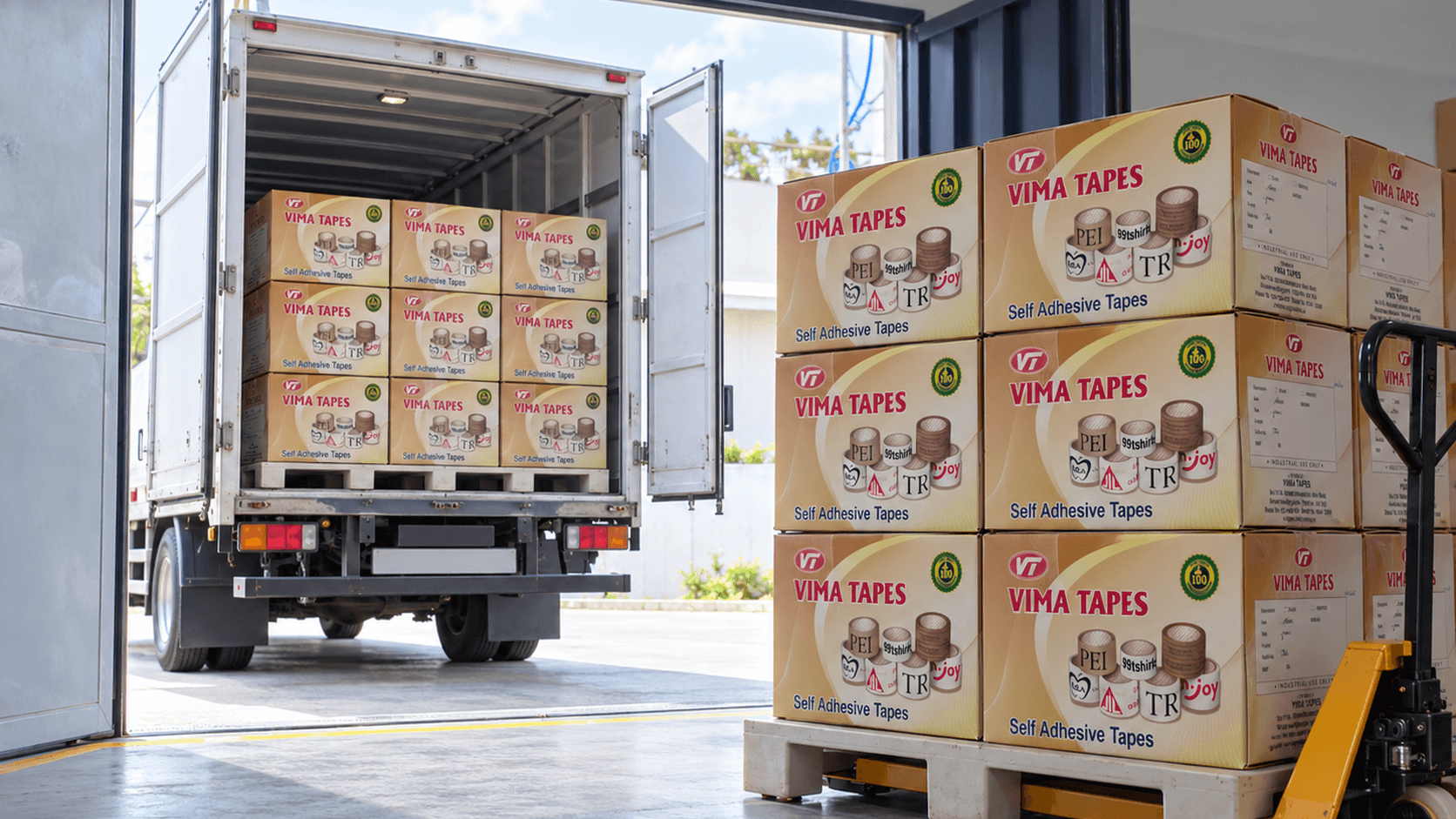
Safe Dispatch, Logistics & Customer Support — VIMA TAPES

Once the cartons have been packed and checked, VIMA TAPES coordinates the order for collection or delivery. Product identification, carton count, destination details and the agreed transportation method are reviewed so the prepared material can move from the manufacturing works to the appropriate buyer, warehouse or transport service. Our sales office in Tirupur coordinates with manufacturing and dispatch teams to support a practical and efficient delivery process.

For applicable local deliveries, VIMA TAPES may arrange delivery through its own local distribution coordination. For other routes, the business works with local courier services and logistics partners according to the customer location, shipment quantity and the transport option agreed during the order. Some commercial customers and distributors also choose to arrange their own pickup from the relevant facility. Each approach has different timing and documentation requirements.

Indicative Production / Dispatch Readiness

Transparent & Brown TapesWithin 3 days

Target for standard confirmed configurations

Colour Tapes3–5 days

Indicative preparation window

Custom Printed Tapes5–7 days

Indicative window after artwork and job approval

These are indicative order preparation or dispatch-readiness timeframes communicated for the VIMA TAPES process. They are not automatic guarantees that a parcel will be delivered to every destination within the same number of days. Final scheduling depends on material availability, order volume, artwork and printing-cylinder readiness, exact size and grade, approval status, transport availability and the confirmed commercial arrangement. For special sizes, urgent orders and larger production runs, the sales team communicates the applicable schedule during order confirmation.

Bulk B2B supply is a significant part of the company’s operations. The Avinashi manufacturing site has three coating lines and seven slitter machines within the stated 40,000 sq. ft. facility. This machinery network supports planning for high-volume orders, wholesale replenishment and tailored tape specifications. VIMA TAPES can discuss large requirements with industrial manufacturers, garment exporters, corrugated packaging suppliers, logistics operations and distributors; actual capacity allocation and dispatch dates are confirmed against the production schedule rather than universally guaranteed for orders of every size.

Order Confirmation to Delivery Coordination

  • Requirements discussion: record tape type, adhesive grade, width, metre length, thickness, print requirement and box quantity.
  • Commercial confirmation: share the applicable quotation, minimum order, artwork or proof approval needs and expected manufacturing schedule.
  • Production and packing updates: coordinate customer enquiries with manufacturing progress and packed stock availability.
  • Transport selection: arrange local delivery, courier service, logistics partner movement or customer collection as agreed.
  • Dispatch information: provide available shipment, collection or transport information relevant to the chosen service.
  • Continued support: assist the buyer with enquiries, shipment follow-up and order-related clarifications until delivery is confirmed where tracking information is available.

The customer-support process does not end when the carton leaves the premises. VIMA TAPES aims to maintain responsive communication from the initial enquiry through processing, packing, dispatch and receipt of the order. For courier shipments, the level of live tracking depends on the courier service and the information made available; customers arranging self-collection remain responsible for the onward movement arranged by them.

Industrial packaging users often depend on recurring tape supplies. Through consistent coordination and product identification, VIMA TAPES supports repeat purchases, changes in packing requirements and custom printed packaging orders. The objective is to offer a reliable manufacturing-and-supply experience for buyers seeking a packing tape manufacturer in Tamil Nadu, a carton sealing tape supplier, a custom printed tape manufacturer or direct BOPP tape supply from the Tirupur–Avinashi manufacturing region.

Product-Specific Coordination

Transparent and brown BOPP tapes are suitable for common box-sealing requirements; the order specifies the thickness, width and length. Colour tapes support packaging identification and coding needs, while custom printed tapes add logos, company names or handling messages with customer-approved artwork. Paper gum tape is a separate paper-backed product category that uses different material and adhesive/application routes, so its production, lead-time and packing requirements should be confirmed separately rather than being assumed identical to BOPP tape.

Additional Technical Details & Process Controls — Stage 06

Order planning and realistic production readiness

VIMA TAPES coordinates production and dispatch based on product type, stock position, printing requirements, quantities and the order confirmation. The stated indicative turnaround is within 3 days for standard transparent and brown tapes, 3–5 days for colour tapes and 5–7 days for custom printed tapes. These figures are target preparation or dispatch windows, not an unconditional promise that every customer anywhere will receive material by that date. Printing cylinders, artwork sign-off, unusual specifications and large orders can affect production readiness.

Local delivery, courier and customer-arranged collection

For suitable local orders, delivery may be coordinated directly by the company. For other destinations, VIMA TAPES works with courier and logistics partners to plan the movement of packed cartons. Certain wholesale buyers or industrial customers prefer to arrange their own vehicle or transporter for pickup. Each method requires correct carton counts, destination details and a clear handover arrangement.

Bulk manufacturing and dispatch coordination

A production facility with three coating lines and seven precision slitter machines is equipped to plan different grades and large-volume orders, subject to the available production schedule and raw materials. Bulk orders typically need coordination among sales, production, quality, packing and transport teams. A high-volume request may be organized by product type, size, colour or dispatch batch.

Customer support continues beyond packing

The Tirupur sales and customer support team assists customers with quotations, tape specification selection, artwork coordination, order confirmation, dispatch updates and relevant delivery follow-up. Buyers can clarify whether they need transparent BOPP carton sealing tape, brown cello tape, colour identification tape, private-label or custom logo printed tape, or paper gum tape solutions.

What customers should confirm before placing an order

A clear purchase order helps reduce avoidable mistakes. Useful information includes the product category, thickness or grade, width in millimetres, roll length, colour or approved print file, quantity in rolls or cartons, destination, required dispatch date and preferred collection method. Custom printed tapes also benefit from agreed artwork dimensions, number of print colours and repeat spacing.

Manufacturing + Infrastructure | VIMA TAPES

Our Manufacturing Infrastructure

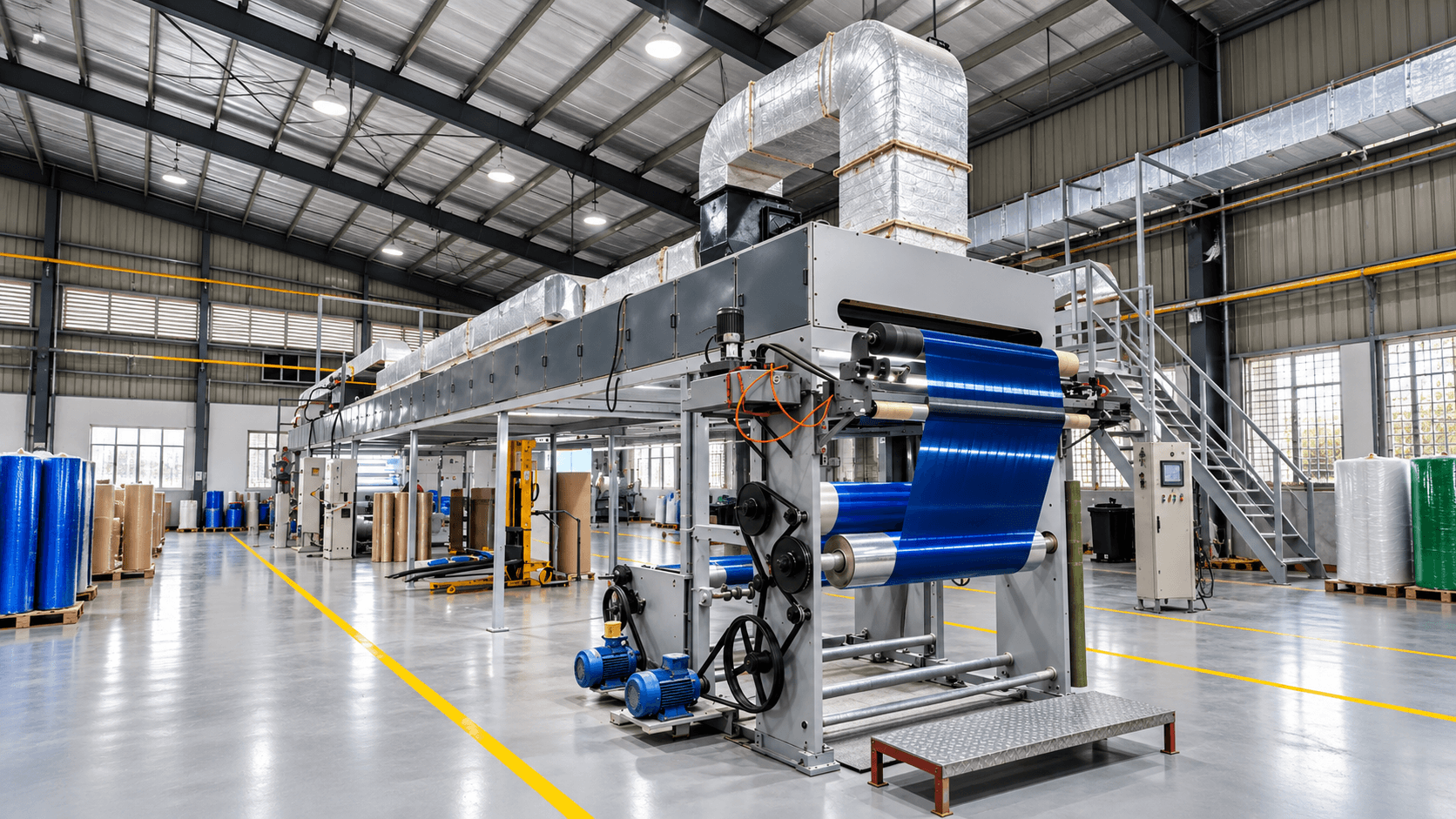
VIMA TAPES Manufacturing Infrastructure — High-Tech Coating Line and Shop Floor

Precision Manufacturing. Reliable Packaging. The VIMA TAPES manufacturing facility supports a carefully organised journey from incoming BOPP film and adhesive material through coating, conversion, inspection, packing and dispatch. Alongside our process stages, the plant infrastructure — machinery, quality laboratory, material handling, environmental systems and experienced personnel — helps connect every part of production.

MANUFACTURING

Spread across 40,000 sq. ft. of state-of-the-art manufacturing space, our facility is purpose-built for efficiency, precision, and high-volume production.

Designed with modern workflows and advanced automation, it ensures seamless large-scale output while maintaining uncompromised quality at every stage.

Our manufacturing capabilities are built around a streamlined production approach that combines precision, process control, and dependable output.

Every stage is carefully managed to maintain uniformity in adhesive application, coating quality, roll formation, and final product performance.

From the manufacturing works in Avinashi, Tirupur District, VIMA TAPES serves requirements for transparent BOPP tape, brown cello tape, colour coding tape, custom printed tape, printed BOPP tape and carton sealing tape for commercial and industrial packaging. Our dedicated Tirupur sales team coordinates specifications and orders with the production operation.

40,000sq. ft. manufacturing space
3BOPP coating lines
7precision slitter machines
100 kWsolar installation — stated site capacity

Material Flow & Factory Layout

A well-planned plant layout reduces unnecessary transfer of material between production stages. Incoming film rolls and approved adhesive are organised for inspection and handling. Prepared BOPP film progresses towards coating; coated jumbo rolls move to conversion and slitting; finished rolls are evaluated, packed and prepared for customer dispatch. This clear sequence helps production staff maintain grade identification and coordinate the movement of multiple widths, lengths and colours.

Material staging, equipment access, workplace housekeeping and safe handling practices support consistent operations. Individual production batches and finished product specifications should remain identifiable throughout the workflow, especially where transparent, brown, colour and printed tape orders run through shared production equipment.

Production Systems

Plant & Machinery

PLANT & MACHINERY

Powered by three high-performance BOPP coating lines and seven ultra-precision slitter machines, our production ecosystem delivers flawless consistency and uninterrupted supply capacity.

Enhanced with automated shrink-packaging systems and international-grade testing equipment, we meet and exceed global quality benchmarks.

Our plant and machinery infrastructure is designed to support efficient, precise, and consistent adhesive tape manufacturing.

Our machinery is configured to maintain accuracy across critical production stages, including coating, slitting, rewinding, and laminating.

Three Coating Lines

Three sets of coating machinery allow production planning across different product configurations and machine capacities. Coating operations depend on controlled film feed, adhesive application, machine speed, web tension and drying. The aim is to form a stable and consistent adhesive-coated BOPP web that can be rewound for later conversion.

Different equipment sizes provide flexibility when planning standard clear tape, brown tape and compatible colour/print production runs. The selected line and settings follow the relevant grade and job requirements.

Seven Precision Slitter Rewinders

Slitting systems convert jumbo rolls into market-ready widths and lengths. Accurate knife positioning, correct core alignment and controlled winding tension help deliver straight edges, neat roll appearance and reliable unwinding. Common requests include 12, 24, 48, 60 and 72 mm widths and 50, 65 or 100 m lengths, according to the product grade.

Production staff examine cutting edges, roll tightness and dimensional compliance before rolls proceed to final inspection.

Printing and Branded Cores

Customer artwork may be transferred using prepared printing cylinders for approved custom-printed tape designs. Print clarity, repeat distance, reading direction and ink colour are important. Pre-prepared VIMA TAPES branded paper cores are used during finished-roll rewinding where applicable; the print belongs on the inner core, not as unintended markings on plain tape surfaces.

Packing and Material Handling

Finishing operations may use grouped roll counting, protective wrapping and carton packing equipment to prepare orders efficiently. The type of wrapping and carton configuration depend on roll dimensions, order size and the agreed packing specification. A separate final check confirms box quantities and product identity before dispatch.

Equipment Maintenance & Operational Discipline

Manufacturing reliability depends on more than machine speed. Routine inspection of rollers, cutting blades, unwind/rewind shafts, drive systems and working surfaces helps reduce preventable stoppages. Operators assess alignment, tension, coating consistency and finished roll condition to detect changes during a production run. Maintenance plans, operator training and housekeeping support safer and more predictable production.

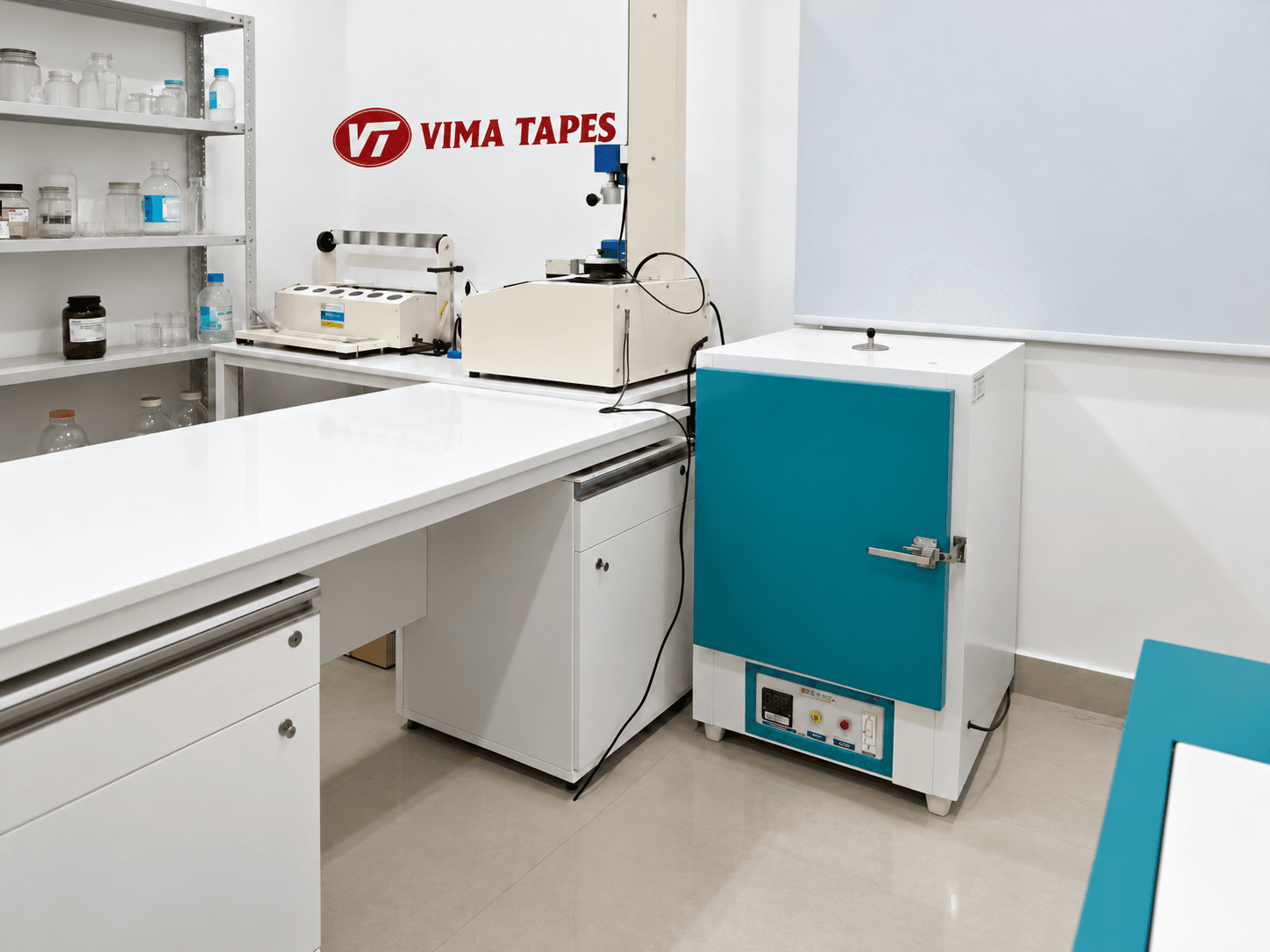
VIMA TAPES Quality Assurance Lab
Testing Laboratory

VIMA TAPES Quality Testing Lab

Dedicated testing facility for raw material inspection, peel adhesion, viscosity, shear holding power, and tensile elongation.

Incoming and Finished-Product Testing

Lab Facilities & Quality Assurance

LAB FACILITIES

Our fully equipped quality-assurance lab conducts a rigorous suite of tests to ensure every roll meets exacting performance standards.

Assessments include Solid Content Strength, pH (Viscosity) analysis, Foaming evaluation, Peel and Shear Strength, Rolling Ball Adhesion, and Tensile Strength—ensuring consistent reliability, durability, and superior bonding across every batch.

Our laboratory facilities support systematic testing and evaluation at different stages of product development and manufacturing.

Products are evaluated against key performance parameters such as adhesion, tack, peel strength, thickness and tensile properties.

Early-stage evaluation helps maintain consistency in manufacturing.

Comprehensive Raw Material Quality Inspection

At VIMA TAPES, quality assurance begins before the actual manufacturing process. Our laboratory testing activities play an important role in evaluating the raw materials used for manufacturing BOPP self-adhesive tapes, including polypropylene film and water-based acrylic adhesive.

Incoming materials are assessed for relevant characteristics that may influence production efficiency, coating uniformity, adhesive performance, and finished tape quality. This helps our manufacturing team identify potential material inconsistencies before they affect large-scale production.

Water-Based Acrylic Adhesive Testing

Water-based acrylic adhesive, commonly referred to as gum, is one of the most important components in adhesive tape manufacturing. Before entering the coating process, the adhesive is evaluated through important laboratory tests that provide information about its physical and chemical characteristics.

Viscosity Testing

Viscosity measures the resistance of the adhesive to flow. It plays an important role in determining how smoothly the gum spreads across the BOPP film during coating. Monitoring viscosity helps maintain consistency in adhesive application and supports uniform coating thickness.

pH Testing

The pH test measures the acidity or alkalinity of the water-based acrylic adhesive. Maintaining the appropriate pH range is important for adhesive emulsion stability and manufacturing consistency. Changes in pH may influence the behaviour of the adhesive during processing.

Solid Content Testing

Solid content testing determines the proportion of non-volatile material present in the adhesive formulation. Since the water component is removed during drying, solid content is an important consideration in determining the final adhesive coating weight and maintaining consistent bonding characteristics.

Incoming Adhesive Examination

Before coating, the water-based acrylic polymer adhesive is checked for important processing characteristics. These checks help the team compare the delivered adhesive with the material specification and assess its suitability for stable coating.

Incoming adhesive testReported valueWhat it tells the team
Viscosity54.16Resistance to flow and its effect on pumping, metering, spread and coating uniformity
pH9.57Acid/alkali condition of the adhesive system and potential effects on emulsion stability
Solid content19.77Non-volatile fraction relevant to wet-to-dry coating calculations

These are the values supplied for an adhesive sample; units, testing methods, test temperatures, acceptance ranges and batch identification have not yet been provided. They should not be represented as universal acceptance criteria.

Additional Tests & Their Purpose

Foaming Evaluation

Foam entrapped in an adhesive may affect transfer, coating appearance and continuity. Observing foam tendency supports handling and process decisions; the exact method and limits should follow the applicable internal procedure.

Peel Adhesion

Assesses the force needed to remove a bonded tape from a specified substrate under controlled conditions. Results require an identified test method, dwell time, width and measurement units.

Shear Holding

Assesses adhesive resistance to creep or slip under a sustained load parallel to the bond. The time result is meaningful only with test geometry, load, temperature and substrate documented.

Rolling Ball Tack

Examines initial tack characteristics using a rolling-ball method. The reported distance and units must be compared against the relevant procedure; shorter distance is generally associated with higher initial tack under equivalent conditions.

Thickness and Dimensions

Measures tape composite thickness, width and finished length. Checks distinguish declared nominal specifications from actual sample results and help prevent shipping the wrong roll dimensions.

Tensile Strength & Elongation

Characterises the film/tape under tensile load and helps identify mechanical behaviour relevant to unwinding and handling. Numerical performance varies by backing construction and test conditions.

COA Review and Batch Records

The two transparent tape COA sample tables remain in the Finished Tape Quality Inspection & Certificate of Analysis process step below. They are intentionally kept separate because a 45-micron tape sample and a 48-micron tape sample have different material constructions and measured values. They must not be merged into a single grade guarantee. Where a customer's technical purchasing process requires it, batch-specific documentation can be reviewed against the agreed tape specification.

VIMA TAPES 100 kW Rooftop Solar Panel Facility
Green Energy

Sustainable Factory Infrastructure

100 kW clean rooftop solar power, in-house zero-discharge Effluent Treatment Plant (ETP), and air-purification scrubber systems.

Environmental Management

Environment, Energy & Responsible Operations

ENVIRONMENT

Our in-house ETP enables responsible waste management and complete environmental compliance.

A 100 kW solar installation powers a major share of our operations, significantly reducing our carbon footprint.

Additionally, advanced scrubber systems ensure effective odor control and air pollutant filtration in line with regulatory standards.

We continuously look for ways to optimise the use of raw materials, energy, water, and other resources throughout our operations.

Better production planning, controlled operations, and systematic handling help us make more effective use of resources.

We aim to incorporate environmentally conscious practices into our day-to-day manufacturing operations.

Our Approach to Responsible Manufacturing

At VIMA TAPES, we recognize the importance of integrating environmental responsibility into modern industrial manufacturing. As an adhesive tape manufacturer based in Avinashi, Tirupur, Tamil Nadu, our approach focuses on balancing efficient production with responsible resource management and environmental awareness.

Our manufacturing operations involve multiple processes, including BOPP film handling, water-based acrylic adhesive coating, drying, slitting, rewinding, packaging, and dispatch. Each stage presents opportunities to improve material utilization, minimize avoidable wastage, and maintain organized production practices.

Through production planning, infrastructure improvements, and systematic operational management, VIMA TAPES aims to support consistent manufacturing performance while reducing unnecessary resource consumption.

In-House Effluent Treatment Plant (ETP)

The stated in-house ETP forms part of the site's approach to managing relevant wastewater streams. An effluent treatment system may involve collection, treatment, monitoring and handling according to the types of process streams produced. Operational effectiveness and regulatory compliance depend on verified permits, treatment records and test results; the presence of an ETP alone is not evidence of full compliance.

100 kW Solar Installation

The site describes a 100 kW solar installation that contributes renewable electricity to facility operations. Its actual share of energy consumption depends on generation, operating hours, connected loads and grid supply. Solar power can reduce reliance on conventional electricity sources; a quantified carbon-reduction figure would require measured power and emissions data.

Scrubber and Air-Handling Systems

The site reports scrubber equipment intended to support odour management and filtration of relevant exhaust streams. Equipment selection, airflow, maintenance and monitoring all influence actual performance. Scrubber performance and regulatory status should be substantiated with plant records before numerical effectiveness or full-compliance claims are made.

Resource Efficiency in Daily Production

Responsible operations also depend on accurate material requirements, controlling avoidable adhesive and film waste, managing production changeovers, minimising offcuts where practicable, and ensuring orderly storage and handling. Good planning supports both business efficiency and more considered resource use.

Publication verification: The descriptions above retain the statements supplied from the existing website. Before publication, verify any absolute expressions such as “complete environmental compliance,” “significantly reducing our carbon footprint,” “international-grade,” and “meets and exceeds global benchmarks” against available site permits, test records and certifications. The detailed descriptions deliberately avoid treating these phrases as independently verified facts.
Planning, Capacity & Customer Requirements

Manufacturing Scale, Bulk Orders & Supply Coordination

With three coating lines, seven slitting machines and a 40,000 sq. ft. facility, VIMA TAPES has an infrastructure basis for planning production across multiple sizes and packaging requirements. Product specifications, materials, machinery availability, conversion schedules, printed artwork approval, packing formats and transport arrangements all affect a particular order's production and dispatch timeline.

The previous Infrastructure page also describes output of 800+ boxes per day and 60,000+ pieces daily. These figures are retained here as site-stated capacity indicators pending confirmation, not production guarantees. Actual output will vary with roll width, length, thickness, coating speed, printing complexity and packaging configuration.

For printed packaging tape and custom logo tape requirements, the sales team helps gather the requested base colour, artwork, print arrangement, widths, lengths and box quantity. Your stated minimum order of one box applies to approved custom-printed tape offerings, subject to confirmation of the specific job and configuration; it should not be described as an unconditional MOQ for every product.

Applications Supported by the Infrastructure

Our manufacturing and dispatch planning serves corrugated carton sealing for textiles and garment exporters in Tirupur; warehouse, logistics and e-commerce packing; repeat B2B wholesale supply; custom printed tape with company logos; colour tape identification and sorting; and suitable paper gum tape requirements. Each application should be matched with its proper product grade and construction rather than assuming one formulation is ideal for all use cases.

Industries & Packaging Applications

The finished adhesive tapes are used in businesses that need consistent box sealing, organization, identification or branded packaging. Application suitability depends on the particular tape construction, handling conditions and carton surface.

  • Textile, garment, and engineering industries in Tirupur, Coimbatore & Erode: outer carton sealing for fabric, garments, engineering components, accessories and export packing.
  • E-commerce and courier businesses: box closure, shipping-carton packing and branded package presentation.
  • Warehouses and logistics centres: carton sealing, colour coding, sorting and dispatch identification.
  • Industrial manufacturing: packing finished goods, spare parts and engineering components for transfer or shipment.
  • Wholesalers and distributors: recurring bulk carton-sealing tape requirements across several common widths and roll lengths.
  • Retail and private-label brands: custom printed packaging tape with logos, company names or handling instructions.

As a BOPP tape supplier and custom printed tape manufacturer based in the Tirupur and Avinashi industrial corridor, VIMA TAPES serves buyers across Coimbatore, Erode, Salem, Karur, Chennai, and all over South India looking for packing tape, brown cello tape, transparent packing tape, printed BOPP tape and other industrial carton sealing solutions. Geographic searches such as “BOPP tape manufacturer near me” or “cello tape manufacturer near me” are best supported by accurate business-location details, not by repeating those exact phrases throughout the page.

Manufacturing Process — Frequently Asked Questions

What is the main raw material used in transparent and brown BOPP tape?

Biaxially Oriented Polypropylene film is the backing material, combined with a suitable pressure-sensitive adhesive layer. The selected film and coating specification depend on the required tape grade.

Why does VIMA TAPES test adhesive before coating?

Viscosity, pH and solid content help evaluate incoming adhesive consistency, coating behaviour and dry adhesive deposition. Test results are interpreted against approved methods and control ranges.

How many coating-machine sets are used?

VIMA TAPES has stated that it uses three different advanced coating-machine sets of varying sizes to support different production requirements.

How are printed tapes manufactured?

Approved artwork is adapted to an appropriate printing-cylinder process. The print construction and sequence depend on whether the tape is surface printed, reverse printed or uses a particular base colour.

Which tape widths can be produced?

Previously shared standard widths include 12, 24, 48, 60 and 72 mm. One-, two- and three-inch widths are common terms used for 24, 48 and 72 mm rolls.

What is checked in a COA?

A batch COA may record thickness, dimensions, peel adhesion, shear holding and tack measurements. The exact parameters, methods and limits depend on the product and agreed testing requirements.

Are the 45- and 48-micron test reports the same sample?

No. They are separate transparent-tape sample records with different dimensions, target ranges and rolling ball tack units.

Is paper gum tape made from BOPP film?

No. Paper gum tapes use a paper backing, generally kraft paper; their adhesive and application systems depend on the specific paper tape variant.

Does VIMA TAPES support bulk and custom printed orders?

VIMA TAPES supports bulk B2B enquiries and has stated a minimum order of one box for relevant custom printed tape configurations, subject to product and artwork confirmation.

How are orders dispatched?

Dispatch can be coordinated through applicable local courier/logistics partners or customer-arranged pickup, depending on order requirements and transport arrangements.

Technical publication note: Source-specific example figures are drawn from the two transparent tape COA snapshots and the adhesive results supplied for this page. General process explanations describe standard industrial tape production practices and must be verified against VIMA TAPES’ actual work instructions before being published as plant-specific operating procedures. Avoid representing any batch result as a guaranteed value for all products.

Request Factory Direct Pricing

Connect with our Tirupur sales team and Avinashi production coordinators for customized tape dimensions, thicknesses, and printed branding.

VIMA TAPES

VIMA TAPES is a leading BOPP packaging tape manufacturer in Tirupur, Tamil Nadu, specializing in plain, printed, and customized adhesive tapes. We offer competitive bulk pricing, a minimum order of just 1 box, and reliable delivery across India and international markets.

FacebookInstagramYouTubeX (Twitter)

Location

Office :1/1 B, 'Vima Towers' Building, Maruthachalapuram Main Road, Kumaranandhapuram West 7th Street, TIRUPUR - 641 602,Tamil Nadu, India
Works :285/1A2, 'Vima Garden', Pudhupalayam Road, AVINASHI - 641 654,Tamil Nadu, India
Copyright © 2026 Vima Tapes
WhatsApp
Chat on WhatsApp